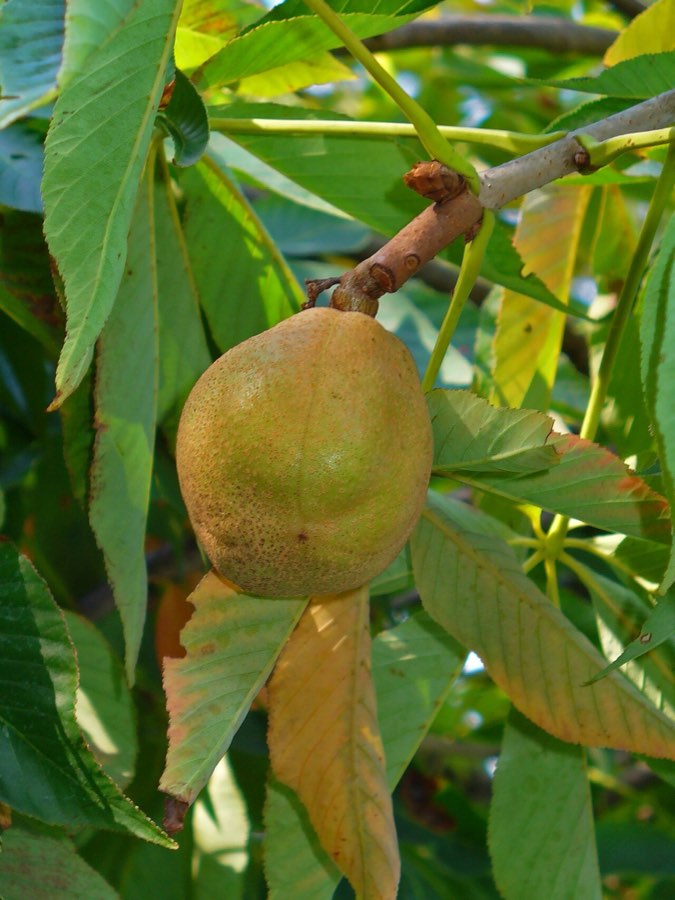
Can be deadly to eatNot a skin hazard.
Never eat a wild plant unless you are 100% certain what it is. Don't touch or eat any plant you don't know, and wash your hands after working in the garden or walking in the woods.
Identify
- Leaves. Hand-shaped: 5 to 9 leaflets spreading from one point like fingers.
- Husk. Leathery, with a few short, soft spines or bumps, easy to handle. It splits into 3 parts.
- Seeds. One to three shiny, dark brown seeds with a pale scar.
Why it's dangerous
- Seeds, leaves and bark are poisonous. Eating enough can be fatal.
- Symptoms. Muscle weakness, paralysis, dilated pupils, vomiting, diarrhea and stupor.
Chestnut or buckeye?
- Burr. A true chestnut's burr is very prickly (handle it with leather gloves) and splits into 2 or 4 parts.
- Leaves. Chestnuts have single, long, narrow leaves with a tooth at the end of each vein.
- Nut. Sweet chestnuts tend to be more pointed; horse chestnuts are smoother. But individual nuts vary, so don't go by the nut alone.
- Rare in the wild. Chestnut blight has made the American chestnut nearly extinct in its natural range.
What to do
- Call Poison Control if anyone ate any part.
POISON CONTROL1-800-222-1222
Free, 24 hours, anywhere in the US. If someone collapses, has a seizure, has trouble breathing or can't be woken up, call 911 now.
SOURCES
Clemson Home & Garden Information Center (HGIC 1031, 3270); Illinois Extension; NC State Extension; Missouri Department of Conservation; New York Botanical Garden. Checked Nov 17, 2026.
Doomkit is a reference, not a substitute for emergency services. In an emergency, call 911.