Rash from touchingEvery part. Never burn it: the smoke can be deadly.
Never eat a wild plant unless you are 100% certain what it is. Don't touch or eat any plant you don't know, and wash your hands after working in the garden or walking in the woods.
Identify
- Where. Only wet places: bogs, swamps, marshes and wet woods.
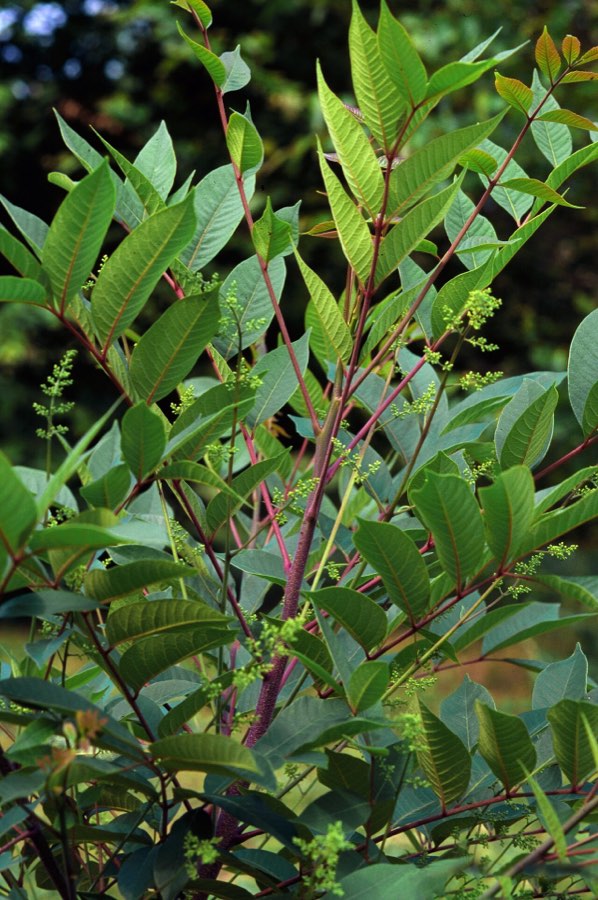
- Leaves. 7 to 13 (sometimes 15) smooth-edged, pointed leaflets in pairs, with one at the tip.
- Red stems. The leaf stalks are often bright red.
- Berries. Hanging clusters of smooth white or yellowish-white berries.
- Size. A shrub or small tree up to 20 feet. Leaves turn bright orange to red in fall.
Why it's dangerous
- Every part. It causes an itchy rash with redness, swelling and blisters.
- The smoke can kill. Burning it puts the oil in the air. Breathing it can swell the airways.
Lookalikes
- Harmless sumacs have red berries. Smooth and winged sumacs carry red berries in spear-shaped clusters. Poison sumac's berries are white and hang down.
- Smooth sumac has toothed leaflets, 11 to 31 of them. **Winged sumac** has leafy wings along the leaf stalk.
- Young ash trees. Ash leaves grow opposite each other on the twig. Poison sumac's alternate.
What to do
- Wash right away, the same as for poison ivy: soap or rubbing alcohol, lots of water, and scrub under your nails.
- Get medical help if the rash is on the face or genitals or covers a large area.
- Call 911 for trouble breathing.
POISON CONTROL1-800-222-1222
Free, 24 hours, anywhere in the US. If someone collapses, has a seizure, has trouble breathing or can't be woken up, call 911 now.
Compare with
SOURCES
Alabama Cooperative Extension ANR-1460; CDC NIOSH; NC State Extension; Virginia Tech Dendrology; University of Tennessee Extension. Checked Nov 17, 2026.
Doomkit is a reference, not a substitute for emergency services. In an emergency, call 911.