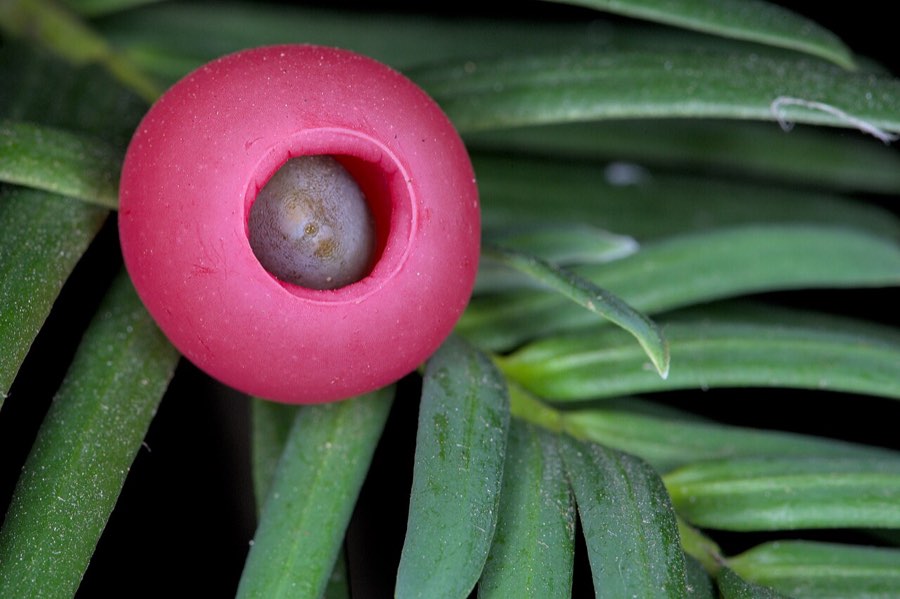
Can be deadly to eat
Never eat a wild plant unless you are 100% certain what it is. Don't touch or eat any plant you don't know, and wash your hands after working in the garden or walking in the woods.
Identify
- Needles. Single needles about an inch long, glossy dark green on top, paler underneath with two yellowish-green bands. Each needle has a tiny stalk.
- Red "berries". A bright red fleshy cup around a single seed, from late summer into fall.
- Stems. Green when new, turning reddish-brown.
Why it's dangerous
- Most of the plant. The bark, needles and seeds are poisonous. The seeds have the most poison. Yew is most poisonous in winter.
- Symptoms. Trembling, slow pulse, dilated pupils, trouble breathing, stomach pain, vomiting, seizures and collapse. It can be fatal.
Lookalikes
- Pine. Pine needles grow in bundles of 2, 3 or 5. Yew needles grow one at a time. Pines also have woody cones.
- Eastern hemlock (the tree). Often confused with yew. It is not poison hemlock.
What to do
- Get medical help right away.
- Don't make them throw up unless Poison Control or a doctor tells you to.
POISON CONTROL1-800-222-1222
Free, 24 hours, anywhere in the US. If someone collapses, has a seizure, has trouble breathing or can't be woken up, call 911 now.
SOURCES
MedlinePlus (National Library of Medicine); NC State Extension; Virginia Tech Dendrology; Cornell Small Farms. Checked Nov 17, 2026.
Doomkit is a reference, not a substitute for emergency services. In an emergency, call 911.