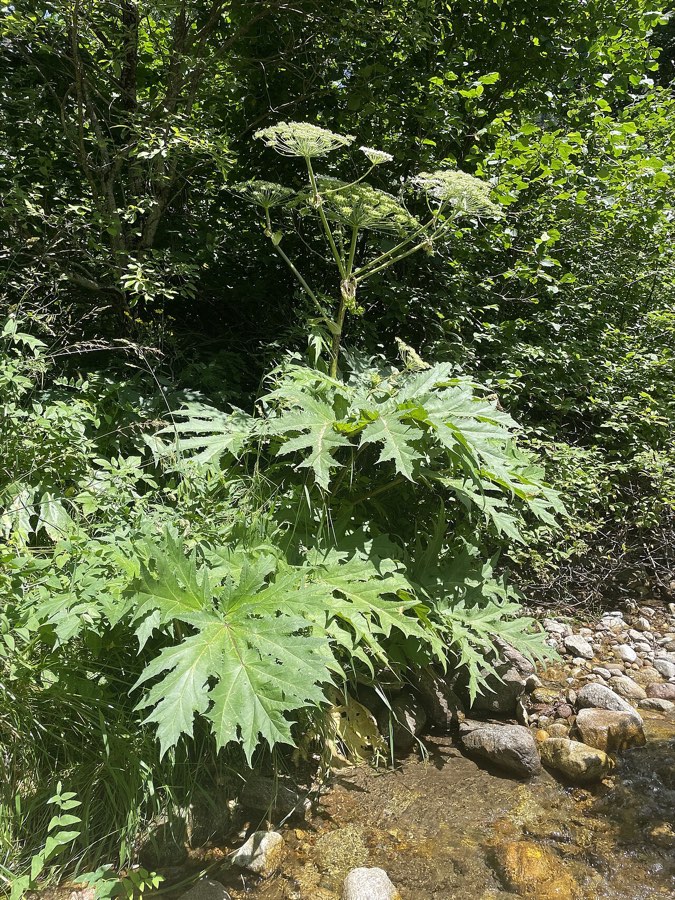
Sap burns skin in sunlightGiant hogweed sap in the eyes can cause blindness. Don’t touch it.
Never eat a wild plant unless you are 100% certain what it is. Don't touch or eat any plant you don't know, and wash your hands after working in the garden or walking in the woods.
Identify
- Giant hogweed. 7 to 14 feet tall or more, with white umbrella-shaped flower clusters up to 2½ feet wide and deeply cut leaves up to 5 feet wide.
- Giant hogweed stem. Green with purple blotches and coarse white hairs, 2 to 4 inches thick.
- Cow parsnip. 5 to 8 feet tall, with white flower clusters up to 1 foot wide, less deeply cut leaves, and a 1 to 2 inch stem with fine white hairs.
- Where. Stream and river banks, open woods and old pastures. Giant hogweed is found only in scattered patches.
Why it's dangerous
- Sap plus sun. The sap, stems, leaves and fruit make skin extra sensitive to sunlight. Reactions range from redness to blisters, burns and scars, starting within 24 hours and worst by 3 days.
- Eyes. Giant hogweed sap in the eyes can cause permanent blindness.
Lookalikes
- Angelica. A smooth, waxy purple stem with no hairs, and ball-shaped flower clusters.
- Queen Anne's lace. Much smaller, 1 to 3 feet, with bristly green stems.
- Elderberry. A shrub whose stems turn brown and woody.
What to do
- Don't touch either plant.
- Wash right away with soap and cold water, then keep the skin out of sunlight for at least 48 hours.
- Eyes. Rinse with water for at least 15 minutes. Get medical care if it doesn't improve.
POISON CONTROL1-800-222-1222
Free, 24 hours, anywhere in the US. If someone collapses, has a seizure, has trouble breathing or can't be woken up, call 911 now.
Compare with
SOURCES
New York DEC; Poison Control (poison.org); Ohio State University Extension ANR-102; NC State Extension; Vermont Department of Health. Checked Nov 17, 2026.
Doomkit is a reference, not a substitute for emergency services. In an emergency, call 911.