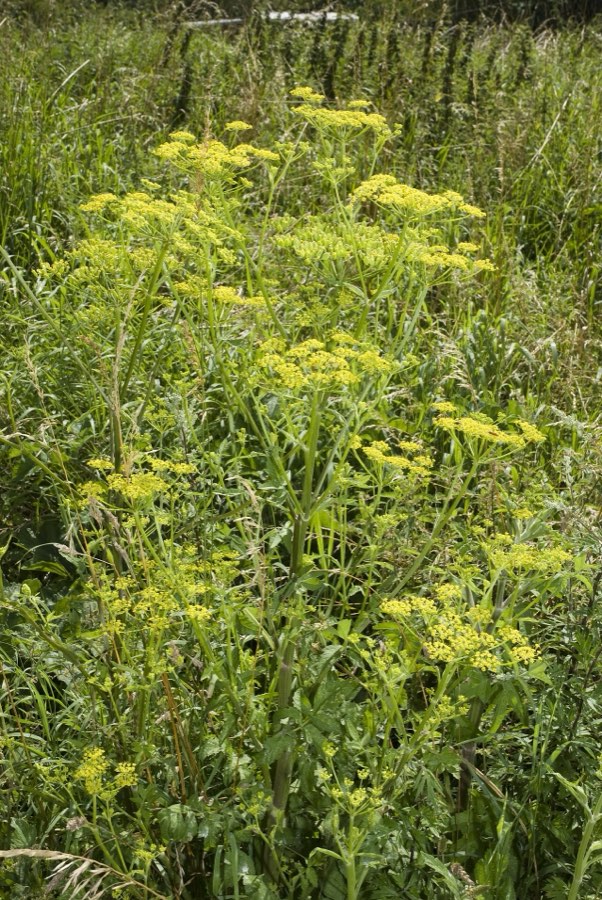
Sap burns skin in sunlightSap on your skin, then sunlight, causes burns and blisters.
Never eat a wild plant unless you are 100% certain what it is. Don't touch or eat any plant you don't know, and wash your hands after working in the garden or walking in the woods.
Identify
- Flowers. Yellow, in flat umbrella-shaped clusters 2 to 6 inches across, in summer.
- Leaves. Divided into pairs of toothed, egg-shaped leaflets, up to about 15, and hairless.
- Stem. Hollow, grooved and hairless, up to 6 feet tall.
- Root. A long taproot that looks and smells like a garden parsnip.
- Where. Sunny roadsides, rail lines and fields, throughout the US. It doesn't grow in shade.
Why it's dangerous
- Sap plus sun means burns. Sap on the skin, then sunlight, causes something like a severe sunburn: redness, swelling, blisters and pain.
- Lasting marks. Skin can stay discolored and sun-sensitive for up to two years.
- Don't string-trim it. Trimmers spray the sap; people end up speckled with blisters and rashes.
Lookalikes
- Queen Anne's lace. White flowers, blooming later in summer. Wild parsnip's flowers are yellow.
- Poison hemlock and giant hogweed. Related plants with white flowers.
What to do
- Wash with soap and water as soon as possible.
- Keep the skin out of sunlight for at least 48 hours.
- Call a doctor if a skin reaction appears.
POISON CONTROL1-800-222-1222
Free, 24 hours, anywhere in the US. If someone collapses, has a seizure, has trouble breathing or can't be woken up, call 911 now.
Compare with
Giant hogweed and cow parsnip · Poison hemlock
SOURCES
Minnesota Department of Agriculture; Utah State University Extension; Illinois Extension; Vermont Department of Health; Ohio State University Extension ANR-102. Checked Nov 17, 2026.
Doomkit is a reference, not a substitute for emergency services. In an emergency, call 911.