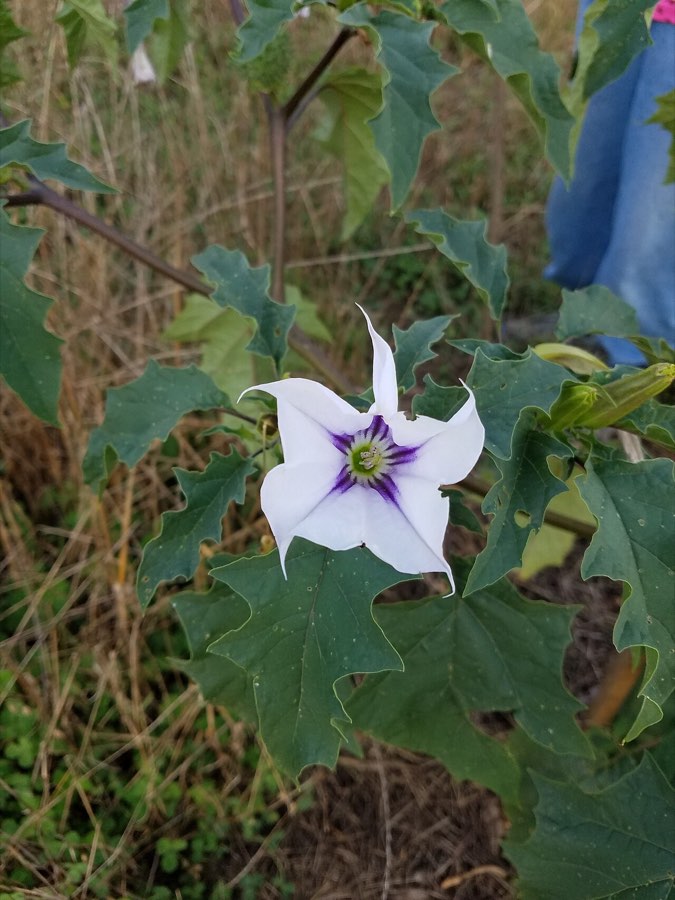
Poisonous to eatThe sap can cause a skin rash.
Never eat a wild plant unless you are 100% certain what it is. Don't touch or eat any plant you don't know, and wash your hands after working in the garden or walking in the woods.
Identify
- Flowers. Trumpet-shaped, white to purple-tinged, sometimes purple inside. July to September.
- Leaves. Large (3 to 7 inches), oval and hairless.
- Stems. Smooth, hollow, green to purple, with many branches.
- Seeds. Each pod holds many flat, black, kidney-shaped seeds.
- Where. Roadsides, fields, pastures and disturbed ground.
- Relatives. Several other daturas look much the same.
Why it's dangerous
- Every part is poisonous. It contains atropine, scopolamine and hyoscyamine.
- Symptoms. Dilated pupils, fever, extreme thirst, flushed skin, poor coordination, confusion, hallucinations, delirium, a fast weak pulse, seizures and coma.
- Even the smell. Smelling the flowers can cause headache and dizziness, and the sap can cause a skin rash.
What to do
- Get medical help right away.
- Don't make them throw up unless Poison Control or a doctor tells you to.
- Speed matters. How well someone does depends on how much they ate and how fast they get treatment.
POISON CONTROL1-800-222-1222
Free, 24 hours, anywhere in the US. If someone collapses, has a seizure, has trouble breathing or can't be woken up, call 911 now.
Compare with
SOURCES
NC State Extension; MedlinePlus (National Library of Medicine). Checked Nov 17, 2026.
Doomkit is a reference, not a substitute for emergency services. In an emergency, call 911.