Can be deadly to eat
Never eat a wild plant unless you are 100% certain what it is. Don't touch or eat any plant you don't know, and wash your hands after working in the garden or walking in the woods.
Identify
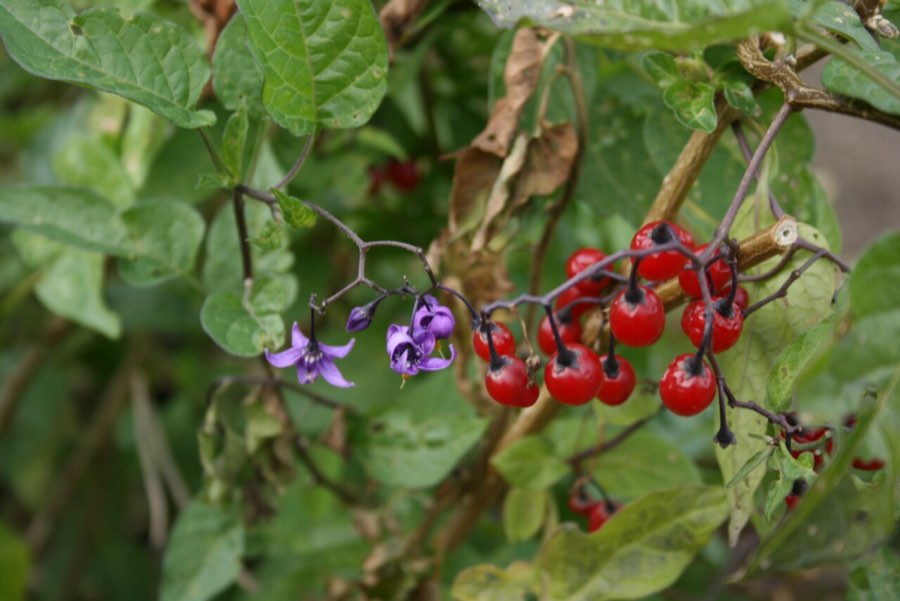
- Bittersweet nightshade. Purple star-shaped flowers with a yellow center, dark green leaves often with two small lobes at the base, and shiny red berries in summer and fall. Wet woods, pond edges, thickets and roadsides.
- Black nightshade. Tiny white star-shaped flowers with a yellow center, and clusters of berries that turn from green to shiny black.
Why it's dangerous
- Bittersweet nightshade. All parts are toxic and may be fatal if eaten, especially the berries and leaves.
- Black nightshade. The leaves and green, unripe berries contain solanine, which is very poisonous even in small amounts.
- Symptoms. Dry mouth, dilated pupils, vomiting, diarrhea, stomach pain, slow pulse, slow breathing and hallucinations.
Lookalikes
- Deadly nightshade (belladonna). Even more toxic, and often confused with bittersweet nightshade.
- Ripe black berries. One extension source says fully ripe black berries can be eaten in small amounts; others list the berries as toxic. Don't eat them.
What to do
- Get medical help right away.
- Don't make them throw up unless Poison Control or a doctor tells you to.
POISON CONTROL1-800-222-1222
Free, 24 hours, anywhere in the US. If someone collapses, has a seizure, has trouble breathing or can't be woken up, call 911 now.
Compare with
SOURCES
NC State Extension; MedlinePlus (National Library of Medicine); Poison Control (poison.org). Checked Nov 17, 2026.
Doomkit is a reference, not a substitute for emergency services. In an emergency, call 911.