Can be deadly to eat
Never eat a wild plant unless you are 100% certain what it is. Don't touch or eat any plant you don't know, and wash your hands after working in the garden or walking in the woods.
Identify
- Where. Wet meadows, swamps, ditches, stream banks and floodplains.
- Stems. Hollow and purple-striped or mottled, up to about 8 feet tall.
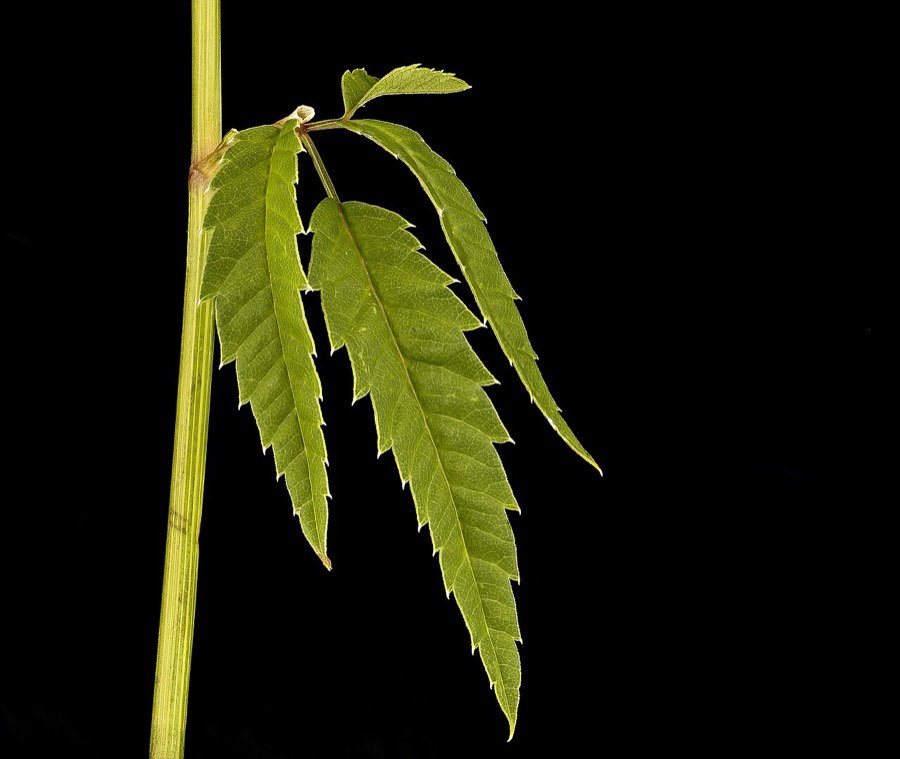
- Leaves. Divided two or three times into toothed leaflets. The leaf veins run to the notches between the teeth, not to the tips. That is the tell that separates it from other carrot-family plants.
- Flowers. Tiny white flowers in umbrella-shaped clusters, spring to fall.
- Root. Thick and chambered: cut lengthwise, it's mostly hollow with cross-walls. A cut root oozes a poisonous yellowish or brown liquid.
Why it's dangerous
- A small bite of root can kill. A piece of root 2 to 3 cm long (about an inch) can be fatal to an adult. Every part is poisonous, the root most of all, especially in spring.
- It seems safe. The root looks like a parsnip, smells like fresh turnip and tastes sweet.
- It works fast. In Maine, a man foraging for wild ginseng had seizures within 30 minutes of eating the root and died about 3 hours later.
Lookalikes
- Wild parsnip, wild carrot and other carrot-family plants. Check the leaf veins. On water hemlock they end in the notches between the teeth.
- Poison hemlock. Also deadly, and also grows in ditches and on stream banks.
What to do
- Call 911 right away. Severe seizures can follow the first symptoms. There is no antidote; hospital care is the treatment.
- Early signs. Nausea, stomach pain and upset within 15 to 90 minutes.
POISON CONTROL1-800-222-1222
Free, 24 hours, anywhere in the US. If someone collapses, has a seizure, has trouble breathing or can't be woken up, call 911 now.
Compare with
SOURCES
CDC, Water Hemlock Poisoning, Maine (MMWR); NC State Extension; Oregon State University Extension. Checked Nov 17, 2026.
Doomkit is a reference, not a substitute for emergency services. In an emergency, call 911.